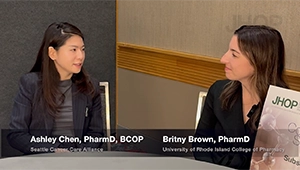
Advances in cancer therapeutics and improved patient survival have increased the complexity of oncology care and the demand for specialized pharmacy services. In response, the 2026 Hematology/Oncology Pharmacy Association (HOPA) Scope of the Oncology Pharmacist Provider defines the qualifications, responsibilities, and institutional support required for oncology pharmacist providers (OPPs) to deliver advanced direct patient care.1 The Scope also outlines the clinical, operational, credentialing, workforce, regulatory, and reimbursement framework needed to support safe, effective, and sustainable OPP practice across oncology settings.
Definition and Core Competencies
An OPP is a pharmacist who is credentialed and privileged to provide direct patient care within applicable laws, regulations, institutional policies, and collaborative practice structures. Depending on their authority, OPPs may select, initiate, modify, and monitor anticancer and supportive care therapies.
OPPs should be able to:
- Apply advanced principles of pharmacotherapy, pharmacokinetics, and pharmacodynamics
- Recognize and manage treatment-related toxicities
- Perform therapeutic drug monitoring and individualize dosing
- Incorporate precision oncology and pharmacogenomics into treatment decisions
- Oversee sterile compounding and the safe handling of hazardous drugs in accordance with United States Pharmacopeia (USP) General Chapters <797> and <800>
- Educate patients and caregivers while supporting informed consent, treatment adherence, and survivorship care planning
- Collaborate with the interprofessional care team, document patient care, and lead quality-improvement activities.
Practice Models and Care Settings
OPP practice models vary by organizational needs, patient populations, and resources. Some OPPs practice across tumor types; others specialize in breast, thoracic, or hematologic oncology.
OPPs may also specialize in specific care processes, such as oral anticancer therapy management, infusion services, or sterile compounding oversight. Other areas of specialization include precision oncology, pharmacogenomics, hematopoietic stem cell transplantation, cellular immunotherapy, survivorship, and palliative care. Many organizations use hybrid disease-specific, treatment-specific, and operational models.
Clinical Services and Impact
OPPs evaluate treatment appropriateness, individualize and monitor therapy, identify medication-related problems, educate patients, and manage treatment-related toxicities throughout the treatment continuum. Where authorized, OPPs may prescribe medications, order and interpret laboratory tests, and modify anticancer and supportive care therapies.
Published evaluations of OPP practice models have reported improvements in medication adherence, symptom control, patient and clinician satisfaction, care efficiency, and access to care, as well as reductions in clinician workload.2-5 Outcomes vary by practice model, patient population, and study design.
Credentialing and Workforce Development
Formal credentialing and privileging help ensure OPPs have the training, experience, and competence required for their responsibilities. HOPA recommends standardized processes for evaluating initial qualifications and ongoing competency.
Suggested qualifications include the completion of a postgraduate year (PGY)1 pharmacy residency followed by a PGY2 oncology pharmacy residency. Equivalent qualifications may include a PGY1 residency plus at least 2 years of oncology clinical practice or at least 4 years of oncology clinical practice without residency training. Board Certification in Oncology Pharmacy (BCOP) and ongoing competency assessment are strongly encouraged. Additional requirements may include National Provider Identifier registration, Drug Enforcement Administration registration when controlled-substance prescribing is authorized, and institution-specific documentation of privileges and scope of practice.
Expanding OPP services will also require continued investment in workforce development. HOPA recommends increasing oncology residency training opportunities, providing continuing professional education and structured precepting, and training pharmacy technicians and other support personnel. Delegating appropriate operational responsibilities allows OPPs to focus on advanced direct patient care and activities requiring specialized clinical judgment.
Regulatory and Reimbursement Considerations
The authority of OPPs varies by state, practice setting, and institutional policy. Collaborative practice agreements are a common mechanism for authorizing OPP prescribing, laboratory ordering, and protocol-based patient management. Emerging regulatory models based on standards of care may provide greater flexibility for qualified OPPs who demonstrate the competencies required for their clinical responsibilities.
Despite these advances, reimbursement for OPP-provided clinical services remains inconsistent. In general, pharmacists lack uniform federal recognition that permits independent billing for evaluation and management services. Some state Medicaid programs and private payers offer reimbursement opportunities, but eligibility, covered services, and payment methods remain variable. HOPA therefore supports policies that establish reimbursement for OPP-provided clinical services, integrate OPPs into value-based care models, and recognize OPPs as members of the oncology care team.
Operational Requirements
Organizations must provide the staffing, technology, infrastructure, and oversight necessary for OPPs to deliver advanced clinical services safely. Essential operational requirements include compliance with USP General Chapters <797> and <800> that govern sterile compounding and hazardous drug handling.
The integration of OPPs into electronic health record workflows should include standardized documentation templates, treatment plans, order sets, and clinical decision-support tools. The appropriate use of pharmacy technicians and other support personnel can improve workflow efficiency and preserve OPP time for advanced direct patient care.
Effective quality and safety systems include clearly defined responsibilities, independent verification procedures when appropriate, medication error reporting, review of clinical interventions, and measurement of clinical and operational outcomes. Regular evaluation of these systems helps identify opportunities to improve patient care and reduce medication-related risk.
OPP Implementation Priorities
Implementing OPP practice models requires coordinated regulatory, educational, institutional, and reimbursement action. HOPA recommends that healthcare organizations, professional associations, and policymakers:
- Establish standardized credentialing and privileging processes based on defined competencies
- Expand PGY2 oncology pharmacy residency training opportunities
- Promote BCOP certification and ongoing competency assessment
- Support regulatory pathways that authorize qualified OPPs to provide advanced direct patient care
- Establish sustainable reimbursement mechanisms for OPP-provided clinical services
- Develop and disseminate implementation resources, including collaborative practice agreement templates, electronic health record tools, competency frameworks, and training curricula
- Invest in pharmacy technicians and other support personnel to facilitate appropriate delegation of operational responsibilities.
Conclusion
OPPs can help address the increasing complexity of oncology care through specialized expertise in medication management, supportive care, and treatment optimization. Fully realizing the value of OPP services will require standardized privileging, supportive regulatory and reimbursement pathways, and sustained institutional investment in workforce development and practice integration. As cancer therapies evolve and demand for oncology services grows, the 2026 HOPA Scope of the Oncology Pharmacist Provider offers a roadmap for implementing and expanding OPP services, improving access to high-quality, team-based oncology care, and strengthening the oncology workforce.
Acknowledgment
The authors thank the members of the 2026 HOPA Scope of the Oncology Pharmacist Provider Task Force: Lisa M. Holle, Jill Bates, Sara L. Fleszar, Eve M. Segal, Kelly M. Brunk, Julie Kennerly-Shah, Elizabeth A. Koselke, Frank A. Nyanin, Jolynn K. Sessions, and Kate D. Jeffers Taucher.
The authors also thank HOPA members Jasmin Eugene, Crystal Heise, and Jennifer Tobin for contributing to the development of the content outline and HOPA staff Noelle Reading and Clarissa Sutker for coordinating meetings and taking notes.
References
- Holle LM, Bates J, Fleszar SL, et al. 2026 Hematology/Oncology Pharmacy Association Scope of the oncology pharmacist provider. Hematology/Oncology Pharmacy Association; 2026. Accessed July 24, 2026. www.hoparx.org/resources/guidelines-standards-and-summaries/
- Indorf A, Kwok M, Jao M, et al. Enhancing multiple myeloma care: implementation of pharmacist-led prescribing of immunomodulatory drugs in an academic medical setting. Clin Lymphoma Myeloma Leuk. 2025;25(6):e424-e434. doi:10.1016/j.clml.2025.01.013
- Johnson L, Khattab S, Strawbridge J, et al. Pharmacist prescribing in cancer services: a scoping review. Res Social Adm Pharm. 2025;21:951-974. doi:10.1016/j.sapharm.2025.05.004
- Andrick B, Tusing L, Jones LK, et al. The impact of a hematopoietic cellular therapy pharmacist on clinical and humanistic outcomes: a RE-AIM framework analysis. Transplant Cell Ther. 2022;28(6):334.e1-334.e9. doi:10.1016/j.jtct.2022.02.015
- Jackson K, Letton C, Maldonado A, et al. A pilot study to assess the pharmacy impact of implementing a chemotherapy-induced nausea or vomiting collaborative disease therapy management in the outpatient oncology clinics. J Oncol Pharm Pract. 2019;25:847-854. doi:10.1177/1078155218765629